

November 10, 2026
By Tri County All Restorations
Black Mold: How to Spot It, What Causes It and How It Is Removed
Mold remediation

Quick answer: Black mold usually means Stachybotrys chartarum, a greenish-black mold that grows on materials that stay wet for days, such as drywall, ceiling tiles and wood after a leak. Its color does not tell you how harmful it is: the CDC advises treating all mold the same way. Find and fix the moisture source, and leave patches larger than about 10 square feet to a professional.
Reviewed by Gary Ackel, owner of Tri-County All Restorations, a Florida licensed mold remediator (MRSR2307) based in Oakland Park. Updated November 2026.
What is black mold?
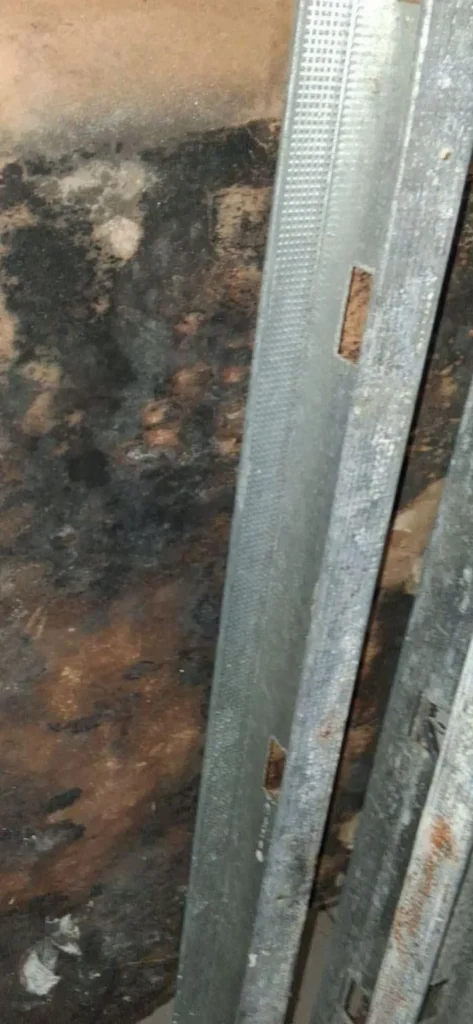
“Black mold” is the common name for Stachybotrys chartarum, a dark greenish-black mold with a slimy look when wet. It needs materials that stay wet for days and feeds on cellulose, the paper and wood fibers in drywall facing, ceiling tiles, cardboard and wood. Many other molds also look black, and only a lab can tell them apart. The CDC says identifying the species is not necessary: the response is the same.
What causes black mold in South Florida homes?
Black mold almost always follows water that sat too long. The most common sources are:
- Slow leaks under sinks, behind toilets and around water heaters
- Roof leaks that soak ceilings and attic insulation
- AC drain pans that overflow onto drywall or flooring
- Floods and storm water that were not dried within 24 to 48 hours
- Constant high humidity in closed rooms and closets
Is black mold dangerous?
For most people, mold exposure causes allergy-like symptoms: a stuffy nose, wheezing, red or itchy eyes and skin irritation. According to the CDC, people with allergies, asthma, lung disease or weakened immune systems can react more strongly. The CDC treats all molds the same with respect to health risks, so the color of the mold should not change how quickly you act. If someone in your home has ongoing symptoms, talk to a doctor.
Can I remove black mold myself?
The EPA says most homeowners can handle a moldy area smaller than about 10 square feet, roughly a 3 by 3 foot patch. If you do:
- Wear an N-95 respirator, gloves and goggles
- Fix the water problem first, or the mold will return
- Scrub hard surfaces with detergent and water, then dry them completely
- Throw away porous items that stay moldy, such as ceiling tiles, carpet and soaked drywall
- Never mix bleach with ammonia or other cleaners
Call a professional for larger areas, mold from sewage or floodwater, mold in the AC system, or growth that keeps coming back.
How do professionals remove black mold?
Tri-County is a Florida licensed mold remediator (MRSR2307) and follows the IICRC S520 standard. We find the moisture source first with thermal imaging and moisture meters. If testing is needed, we arrange an independent licensed assessor. Then we set up containment and HEPA air filtration, remove the affected materials, clean and dry the area, and an independent third party performs clearance testing so you get proof the mold is gone.
How do I keep black mold from coming back?
- Repair leaks as soon as you find them
- Dry anything that gets wet within 24 to 48 hours
- Keep indoor humidity below 60 percent, ideally between 30 and 50 percent, as the EPA recommends
- Run bathroom and kitchen exhaust fans
- Keep the AC drain line clear and have the system serviced yearly
Not sure what you are seeing? Read how to know if you have mold, or learn about our mold remediation in Fort Lauderdale. Call (954) 776-1717, 24/7.
Frequently asked questions
Is black mold more dangerous than other mold?
Not by color alone. Many molds look black, and the CDC advises treating all mold the same way with respect to health risks and removal. What matters is how much is growing, what it is growing on and who lives in the home.
Does black mold have a smell?
Yes. Like most mold, it gives off a musty, earthy smell, similar to damp cardboard. A strong musty smell with no visible mold often means growth inside a wall, under flooring or in the AC system.
Will painting over black mold fix it?
No. The EPA advises against painting or caulking over moldy surfaces. The mold keeps growing underneath and the paint peels. The moldy material has to be cleaned or removed, and the area dried, before any painting.